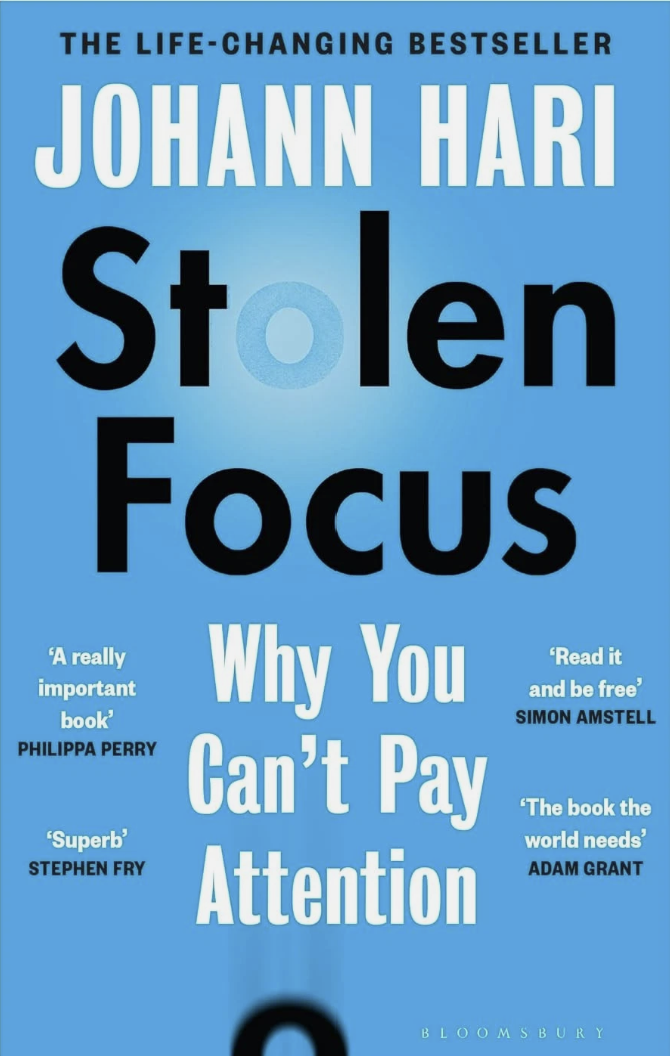
Are you fed up doom-scrolling? Do you find it difficult to read long documents that you could previously? Do you find yourself flitting between tasks?
I was a yes to all three.
This book came to my attention via the amazing Steve Heath when I took part in his mhib Mental Health First Aid Training course. The cover calls it “The Life-Changing Bestseller” – a worn-out phrase that is true in this case.
Johann Hari starts the book by taking himself off to Provincetown – a remote part of the east coast of the USA – without a phone or internet-capable computer, for three months. He needs a detox from doom scrolling. He wants to see if his anxiety will wane and his ability to focus will return. What do you predict?
This book is a wonderful exploration of all the factors that have led us, as a species, to focus less, sleep less, be more depressed, more anxious and have unprecedented levels of diagnosed ADHD in our world.
There are some great little nuggets of information and research findings throughout the book. Did you know, for example, that there is no such thing as “multi-tasking”?
This book explains the benefits of exploring hobbies and interests that will take you into a “flow state”. It explains the difference between how we read books and screens. It explores mind wandering as a positive rather than a negative use of time.
I had already come across the concept of social media design that maximises time spent online to increase advertisement exposure and data harvesting opportunities from Nexus (see my previous book review). But this book delves deeper into this concept and the power of outrage versus happy stories.
Did you know that as a species we sleep one hour less on average every night compared to 1946? This book explores how sleep, the food we eat, and the chemicals that fill our air and the products around us are all affecting our ability to focus.
It also explores how the way we teach our children in schools is not necessarily in synchrony with how our brains are wired to engage and learn. And if you add the prevalence of ADHD symptoms to the mix it is easy to see why schools are struggling to keep classrooms focussed.
You might be thinking, as I was, well what can little old me do about this? See page 268 for some macro ideas around that. But I would be very surprised if you didn’t look at the settings on your phone, as I did, before you finish this book.
At D3 we are committed to coaching Executives in a world full of distractions to help you to focus. Get in touch if you want to explore these concepts 1:1.
Samantha Peat, Executive Coach