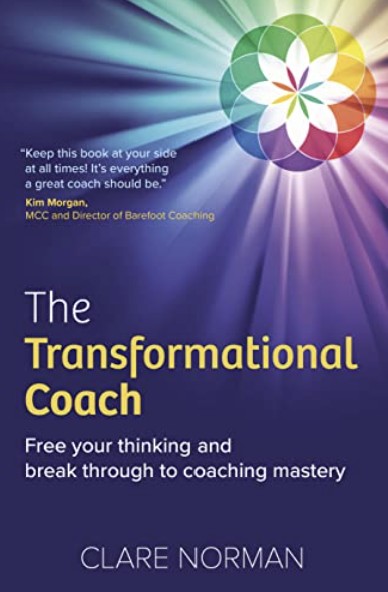
Have we been asking the wrong questions in our coaching relationships?
In this book Clare Norman seeks to take 83 habits learned from parents, school, friends, work and coaching training when asking questions and to shift them from an Old Mindset to a New Mindset.
This book can be used by coaches in the broadest sense – from those of us engaged in leadership coaching, to leaders within business that want to use coaching to get the best out of themselves and their people.
I have picked out a few gems that spoke to me personally but there are many more thought-provoking shift suggestions in the book…
Old mindset: Do what I tell you to do
New Mindset: Provide psychological safety so the thinker can figure out their next move
When I came to coaching the thing that struck me was that coaching is not mentoring – your role is not to use your experience to provide advice and guidance. When I explained this to my husband he said, “What? You’re not allowed to tell people what to do? Well, that’s you scuppered!” (maybe he used a different word). Research shows that if you tell someone what to do it sticks only momentarily. If you coach someone to realise what they want to do next, their new thinking and behaviours are more likely to be longer-term.
As an aside, Clare Norman uses the term “thinker” rather than “coachee” because she believes it promotes an adult:adult equality of relationship rather than a parent:child dynamic that the coach:coachee relationship can foster. This threw me at first but makes a lot of sense.
Old mindset: I must understand everything
New mindset: I don’t need to understand as long as the thinker does
Precious (paid for) coaching sessions can be wasted asking and answering questions that only help the coach and involve the coachee explaining things they already know. The best use of precious coaching time is to ask questions that encourage the coachee/thinker to new thinking that will create greater self-awareness or new patterns of behaviour, unlocking potential and optimising performance.
Old mindset: Offer praise such as ‘great’, ‘interesting’, ‘excellent’
New mindset: Offer positive acknowledgement of who they are
Often, those of us drawn to coaching or wanting to adopt useful coaching tools in a leadership role, if we are honest, have a tendency to be people pleasers who want to be
liked. We want to create a loop of positivity in our dialogue, even if we are just nodding along. Clare Norman explains that the danger of this is that the coachee can take our positive affirmations as agreement or instruction to proceed. Our role as coach is then becoming mentoring. That might be fine and what we have contracted to do but, if we want to coach purely, we are better off acknowledging what the thinker has said, and observing that it is what they have indicated they wanted to achieve.
Old mindset: Think about a clever response before they stop talking
New mindset: Don’t think ahead; stay in the moment
Active listening is one of the first tools coaches (and mental health first aiders) are taught. Actually concentrating on the words said, and the emotions emitted, rather than thinking of the next question or response. Playing back, using the same words or analogy, can prevent misinterpretation or paraphrasing with words not familiar and therefore not useful to the coachee and the process.
Old mindset: Here’s what I would do
New mindset: What is going to work for you, given your personality and context?
Telling a coachee what you would do, or have done, is of limited use to the coachee and could even be unhelpful, because different people have different thoughts and behaviours. If I would have spoken up there and then in a situation and I tell you that’s what I would do, that might not suit your style of leadership or communication and could cause you unnecessary stress if you are trying to be someone you are not. Leaders need to find their own authentic methods.
Old mindset: I am responsible for the outcome
New mindset: I am responsible for the coaching process, the thinker is responsible for the outcome and their future
It is natural for a coach or leader to want a good outcome from coaching others. But a preoccupation with the outcome can lead to coaches manipulating the line of questioning of suggesting solutions. If this approach is adopted, what happens when the coaching relationship ends? The coachee needs to be accountable for the actions they commit to, the timings of those actions, and to be honest about how likely it is they will be diligent about changing.
At D3 Partnership we are continually examining our approach to Executive Coaching so that the time spent with our coachees is maximised and worth the investment of time and money.
Get in touch with D3 Partnership to learn how we integrate these ground-breaking shifts into our executive coaching programmes.
Samantha Peat, Executive Coach