Can coaching help to harness our inner voice? At D3 Partnership, we believe there are methods and tools available to do this. We work with clients to identify Performance Inhibiting Thoughts and turn them into Performance Enhancing Thoughts.
Why does this matter? For sportsmen and women, it matters a lot – harnessing self-talk and allowing automated muscle memory undisturbed is what allowed Simone Biles to achieve the “triple double” manoeuvre. In other events, her self-talk interrupted the flow, and she was unable to compete. Sorry, Rory, but many people have seen Rory McIlRoy “choke” at key golf tournament moments.
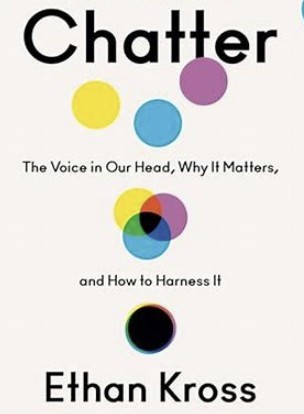
Ethan Kross’s book offers an easy to read and relatable essay on the inner voice. For example, when asking “how intrinsic is our inner voice?” he poses the question, “Have you ever tried to read a book or complete a task requiring focus after a bad fight with someone you love?”
Ethan explores a study in 2010, which found that “inner experiences consistently dwarf outer ones”. That is to say, you can be doing something fun and enjoyable but if you are unhappy at the time that is what you will remember.
My son, Murray went to Harry Potter World with his twin cousins who are 6 months older than him. They were all around 8 years old. Murray discovered on the way to and throughout the day that his cousins knew far more Harry Potter trivia than he did. He couldn’t bear it. It spoiled his day. The photographs from that day are hilarious – you can see that he is trying to smile but you can also see that his is having a miserable time. Can you relate?
This book offers a number of interesting insights. For example, the work of Belgian psychologist, Bernard Rime: “talking to others about our negative experiences doesn’t help us recover in any meaningful way”. Talking to others can in fact make things worse. “In practice, co-rumination amounts to tossing fresh logs onto the fire of an already flaming inner voice”. Rather than rehashing painful details, his research suggests that it is better to move from empathy to cognitive solution formulation as soon as possible, remembering to make physical contact, if possible and appropriate, to make the person dealing with a negative memory feel safe.
Other research is discussed which shows that a room with a view of trees and nature aids better mental health and decision-making than living with an urban view. Something we are perhaps not surprised by but empirically evidenced to form the basis of good social policy.
My favourite part of the book talks about the power of saying your own name and of talking aloud to yourself as a way of creating perspective and distance, thereby improving your ability to deal with life’s stresses. I also found the section on the power of placebo, rituals and faith fascinating.
Ethan Kross’s book ends with a summary of his Toolkit for harnessing the inner voice, including journalling, distanced self-talk and challenge-oriented reframing.
At D3 Partnership we can help you to harness your inner voice and reframe negative self-talk. Get in touch with D3 Partnership to learn how we integrate our understanding of this area of psychology to help you to take better control of your thoughts, emotions and behaviour.
Samantha Peat, Executive Coach